City Context
Known for its active plate tectonics, Vancouver also has deep political fault lines, shaped by differences in wealth, housing tenure, and urban priorities. These divisions make the 2026 civic election particularly consequential.
With just over 740,000 people in a metropolitan region of more than 3 million, Vancouver remains the centre of economic activity and provides one-third of the region’s jobs. Since 2022, 86% of population growth has occurred outside the City, bringing regional issues onto the political agenda, with reform a feature of several candidates’ platforms.
Vancouver continues to draw new immigrants at rates above the provincial average, and immigration continues to drive its population growth. Today, 42% of residents are immigrants and 7% are non-permanent residents, although these rates are lower than elsewhere in the region. More than half (55%) of the city’s population identifies as a “visible minority” – more than 25% as Chinese, 7% as South Asian, and 3% as Filipino.
At the same time, Vancouver has the second highest level of income inequality among Canada’s major cities, after Toronto. Household incomes remain relatively modest, particularly for renters ($63,200 versus $100,000 for owners), and these income disparities are compounded by the high cost of housing in Vancouver.
The costs of both rental and ownership housing are among the highest in the country. As new purpose-built rental housing has entered the market and population growth has slowed following changes to federal immigration policy and shifting patterns of domestic migration, rents have begun to decline, and vacancy rates have increased. However, vacancy remains stubbornly low for units with rents in the lower half of the rental market, where demand remains strongest. New housing development for the lower 40% of household incomes remains exclusively built by the non-market sector.
These affordability pressures are reflected in persistently high levels of housing precarity and homelessness. More than 2,700 people experience homelessness (an increase of 12% since 2023), many of whom are Indigenous and older adult renters. A further 6,500 people are on the precarious edge of homelessness.
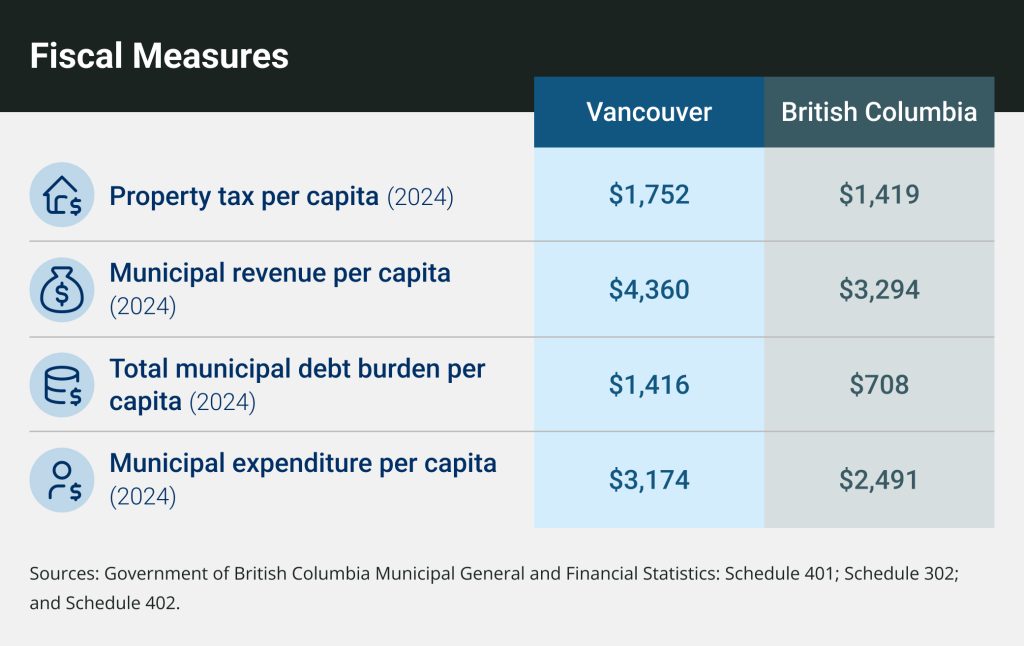
These pressures are unfolding within the City’s broader fiscal context. For 2026–2027, Council approved an increase of its operating budget to $2.39 billion, relying on property tax for the majority (56%) of revenues. After increasing property taxes 21.9% over the previous three years, council committed to a zero-property tax increase, cutting a wide range of services (excluding policing) to do so, including the dissolution of the City’s sustainability department. However, it increased utility fees by 4.2% to fund replacement infrastructure and Metro Vancouver’s increased water and sewer levies. The City’s real (inflation-adjusted) municipal operating spending grew by 2.2%, compared to population growth of 1.4% per year, using compounded annual growth rates from 2010 to 2024.
Vancouver has an independent Office of the Auditor General (OAG) that has issued a number of audit findings, land sales reviews, and operational reviews with recommendations for City departments, as well as mayor and council. As of January 2026, the OAG estimates a positive financial impact of more than $31 million resulting from the City’s implementation of its recommendations, and a return of more than 450% on the investment in the Office of the OAG over two council terms.
Table 1. Demographics
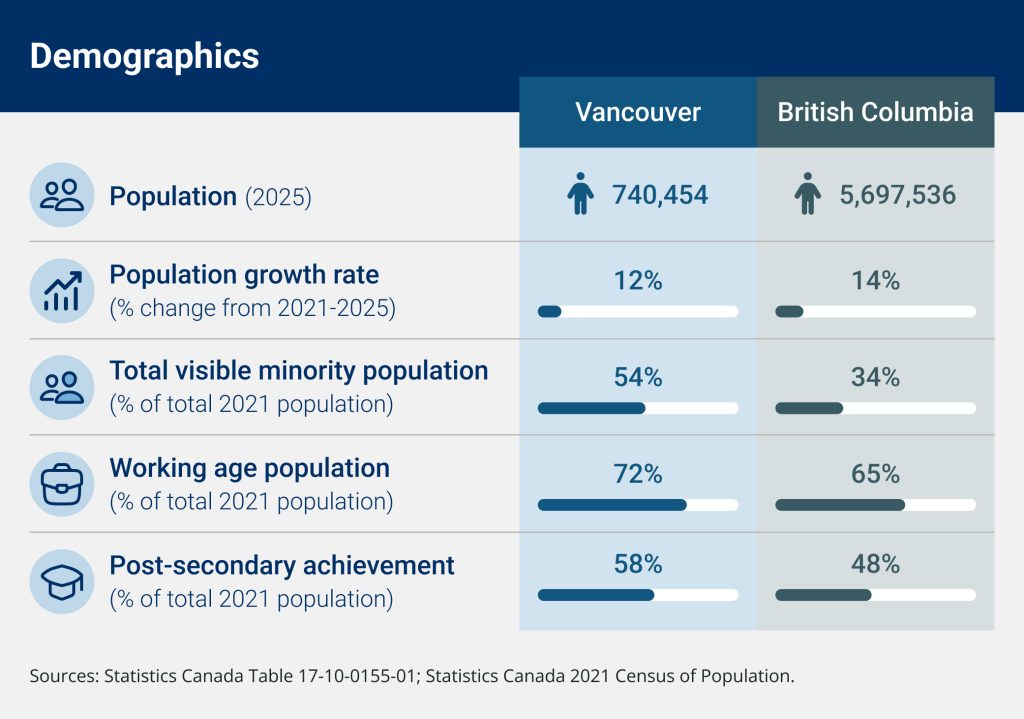
Table 2. Local Economy
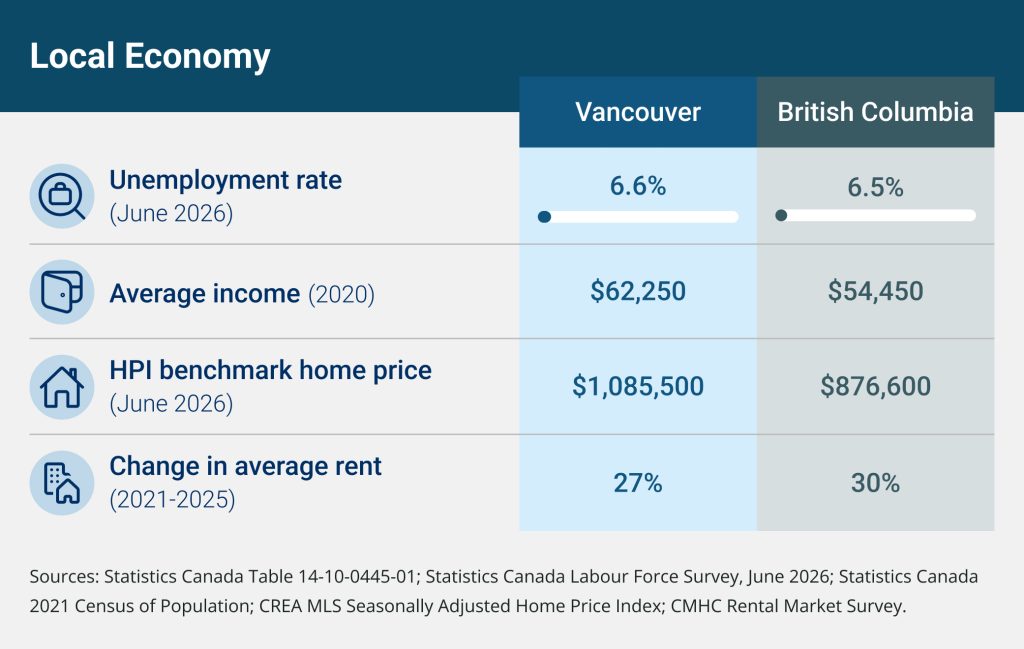
Table 3. Fiscal Measures
The Political Landscape
In addition to asking Vancouverites to vote for a mayor, ten councillors, parks commissioners, and school trustees, the 2026 election ballot will pose three “yes or no” questions: whether the City can borrow $790 million to help pay the capital costs of transportation, community services, and parks infrastructure; and two non-binding questions on the policing of open drug use and on involuntary drug treatment, both issues that transcend municipal jurisdiction.
Vancouver’s political system is distinct from other major Canadian cities in two respects. First, the citywide electoral model means that elected councillors represent the entire city, rather than a particular ward. Voters can choose up to ten candidates, and the ten who receive the most votes form the new council. Second, the system allows councillors to have formal affiliations with political parties. The city also features a “weak” mayor system, where the mayor sits as “first among equals,” one vote among 11, with no veto powers. In practice, the mayor’s power depends on their ability to maintain a stable majority on council, a feat made much easier when the mayor’s party elects a disciplined majority to council. This was seen in 2022 when Mayor Ken Sim and his right-of-centre A Better City Vancouver Electors Association (ABC Party) swept to power with seven of ten council seats. This year’s race sees the party facing challenges from a constellation of partially aligned progressive left-of-centre parties, as well as a former ABC council member and a former ABC staffer forming their own separate parties.
The current council’s relationship with the Province began with collaboration on the Province’s pilot drug decriminalization project and safe consumption sites. Frictions emerged, however, as the Province moved to regulate municipal development, unilaterally densify neighbourhoods, and speed up residential development. The changes eliminated or restricted some policy instruments that the City had used to extract amenities from new residential development and design excellence in the rezoning process, forcing the City to consider alternate funding arrangements or reduced service provision. This has limited the City’s ability to maintain and/or extend the physical, social, and cultural infrastructure necessary to adapt to provincially mandated density and development. One study by the Canadian Urban Institute estimates that on average, every new additional dwelling unit needs $107,000 of housing-enabling infrastructure. Without the ability to extract necessary funds from developers, it remains unclear who will pay, how it’ll be funded, or when the investment will occur.
The last year has also seen a growing chasm between City and Province on other issues. The Province pushed back on City-led changes to the enforcement of public drug consumption and homeless encampments on, among other grounds, their dubious constitutionality. The 2026 plebiscite captures this gap as the City moves to demonstrate popular support for changes to criminal enforcement and medical treatment approaches, despite those measures lying outside municipal jurisdiction, and potentially infringing on people’s constitutional rights.
Key Policy Challenges
As Vancouver enters its 2026 election cycle, the city’s policy challenges are invariably interrelated.
Housing in Vancouver for renters and owners remains decoupled from local incomes. For Vancouver to become affordable, a council (in cooperation with higher levels of government) would need to walk the policy tightrope of lower housing costs, growing incomes, or a combination of both. While the City continues to approve new development, actual construction and market absorption have slowed markedly. The market ownership model depends on investors leveraging a mix of local and international unit purchases and presales, while these have declined due to many factors beyond the City’s direct control. At the same time, City policies related to livability and sustainability also have an impact; for example, tree retention and canopy extension, and building design, energy and heating requirements, influence quality of life but can also constrain development.
Economic development and resilience remain a perennial electoral issue, particularly with regard to building a more productive and diverse economy beyond real estate and tourism. Current questions focus on the pursuit of artificial intelligence data centres and erosion of the city’s industrial/employment land base, given their implications for economic development and job creation, as well as the environment.
Public order constitutes another point of debate. While violent and non-violent reports alike have declined significantly to a 20-year low, according to sources like Statistics Canada’s Crime Severity Index, the two ballot questions demonstrate the continued political salience of policing and public order. In many ways, it is a contest of political framing: are issues of homelessness, mental health, deepening urban poverty, and drug addiction primarily social issues, or matters for the police and criminal justice system?
Governance issues have also emerged as a priority. The federated structure through which Metro Vancouver coordinates shared services, such as water and sewage, has come under increasing scrutiny (owing to high-profile infrastructure cost overruns and its unwieldy decision-making structure). The region faces billions in water and sewage infrastructure renewal and expansion costs to accommodate future population growth and climate change. Adding to the pressures, uneven growth has put greater focus on both intermunicipal distribution issues and uneven burden-sharing. In contrast with previous elections, regional governance seems poised to become a campaign issue.
Accountability and transparency remain on the front burner. Vancouver continues to struggle to maintain enforcement of its code of conduct. The ABC majority on council has put itself in opposition to the City’s non-partisan integrity commissioner, even moving at one point to suspend the office pending an open-ended review.
The 2026 civic election is occurring on unstable ground, as tectonic economic and social pressures build on new and existing fault lines of housing affordability, public safety, and economic uncertainty. The vision of a prosperous and growing city has repeatedly collided with fiscal and operational realities of aging infrastructure, climate change, and a shifting policy environment. The “polycrisis” of the present age heightens both the tensions and the stakes for the city. Provincial directives have shaped housing and fiscal policy while leaving major questions about infrastructure and amenity funding and delivery, areas traditionally under municipal responsibility. The fall election will reveal whether the pressures are enough to trigger an electoral earthquake capable of shaking incumbent leaders out of office and creating a new political formation. Regardless of the outcome, the result will shape the political, social, economic, and physical landscape of Vancouver for years to come.
Notes
City of Vancouver. (n.d.). City of Vancouver Office of the Integrity Commissioner. https://vancouver.ca/your-government/integrity-commissioner.aspx
City of Vancouver. (2020). City of Vancouver Employment Lands and Economy Review. https://vancouver.ca/home-property-development/vancouver-employment-lands-and-economy-review.aspx
City of Vancouver. (2023). City of Vancouver 2023 Budget and Five-Year Financial Plan. https://vancouver.ca/files/cov/2023-budget-final.pdf
City of Vancouver. (2025a). City of Vancouver 2026 Budget. https://vancouver.ca/files/cov/2026-budget.pdf
City of Vancouver. (2025b, November 25). Vancouver City Council approves 2026 Budget with 0% property tax increase. https://vancouver.ca/news-calendar/council-approves-0-property-tax-nov-2025.aspx
City of Vancouver. (2026a). 2026 City of Vancouver Elections. https://vancouver.ca/your-government/2026-election.aspx
City of Vancouver. (2026b, March). City of Vancouver Official Development Plan. https://bylaws.vancouver.ca/odp/odp-vancouver.pdf
City of Vancouver. (2026c, April 8). Vancouver surpasses 2025 housing targets with decades-high rental delivery. https://vancouver.ca/news-calendar/vancouver-surpasses-2025-housing-targets-april-2026.aspx
City of Vancouver. (2026d, June 26). Auditor General releases update on the status of previous audit recommendations. https://vancouver.ca/news-calendar/ag-update-on-the-status-of-previous-audit-recommendations-june-2026.aspx
Fenn, M. (2024). A Jump Start: Providing Infrastructure for More Housing. Canadian Urban Institute. https://canurb.org/wp-content/uploads/A-Jump-Start.pdf
Homelessness Services Association of BC. (2023). 2023 Homeless Count in Greater Vancouver. Greater Vancouver Reaching Home Community Entity. https://hsa-bc.ca/_Library/2023_HC/2023_Homeless_Count_for_Greater_Vancouver.pdf
Homelessness Services Association of BC, Caspersen, J., Baiazova, Z., and Stephen D’Souza. (2025, September). 2025 Point-In-Time Homeless Count in Greater Vancouver. Lu’ma Native Housing Society. https://hsa-bc.ca/_Library/2025_HC/2025_Point-in-Time_Homeless_Count_for_Greater_Vancouver_Final_Report.pdf
Statistics Canada. (2022, February 9). Profile table, Census Profile, 2021 Census of Population—Vancouver, City (CY) [Census subdivision], British Columbia;Vancouver [Census metropolitan area], British Columbia. https://www12.statcan.gc.ca/census-recensement/2021/dp-pd/prof/index.cfm?Lang=E
Statistics Canada. (2024, May 22). Population estimates, July 1, by census metropolitan area and census agglomeration, 2021 boundaries. https://doi.org/10.25318/1710014801-eng
Statistics Canada. (2026a, January 14). Population estimates, July 1, by census subdivision, 2021 boundaries. https://doi.org/10.25318/1710015501-eng
Statistics Canada. (2026b, September 12). Crime severity index and weighted clearance rates, police services in British Columbia. https://doi.org/10.25318/3510006301-eng
Willams, D., and Yunis, J. (2026). The Runaway Train is Accelerating: A Closer Look at the Exceptional Growth in B.C. Municipal Spending. Business Council of British Columbia. https://static1.squarespace.com/static/65b003ec4edede0a855a88d4/t/6a42ac8b91cd074c14d74e36/1782754443921/Municipal+Spending+Follow-06-29-26.pdf
Media Sources
Little, S., and Dao, C. (2023, October 13). Vancouver hires 100 cops, but fewer than 10 promised mental health nurses on board. Global News. https://globalnews.ca/news/10023603/vancouver-police-mental-health-nurse-promise/
Contributors
Stewart Prest
is lecturer in the University of British Columbia’s Department of Political Science.
Andy Yan
is associate professor of professional practicein the Urban Studiesprogram at Simon Fraser University anddirector of the SFU City Program.
Institute on Municipal Finance and Governance
School of Cities University of Toronto
55 St. George St., Suite 853
Toronto, Ontario, Canada
M5S 0C9
e-mail: info.imfg@utoronto.ca
http://imfg.org
Series editors: Kohbod Khandan-Barani and Lisa D. Orchard
Footnote
Click to scroll to footnotes