City Context
Winnipeg has an outsized influence on Manitoba’s economy and politics, as more than half the provincial population calls the city home. Reaching 850,000 people in 2025, the city is growing faster than the province and remains a primary destination for immigrants moving to Manitoba, reflected in the share of the population that identifies as a visible minority (34% in 2021).
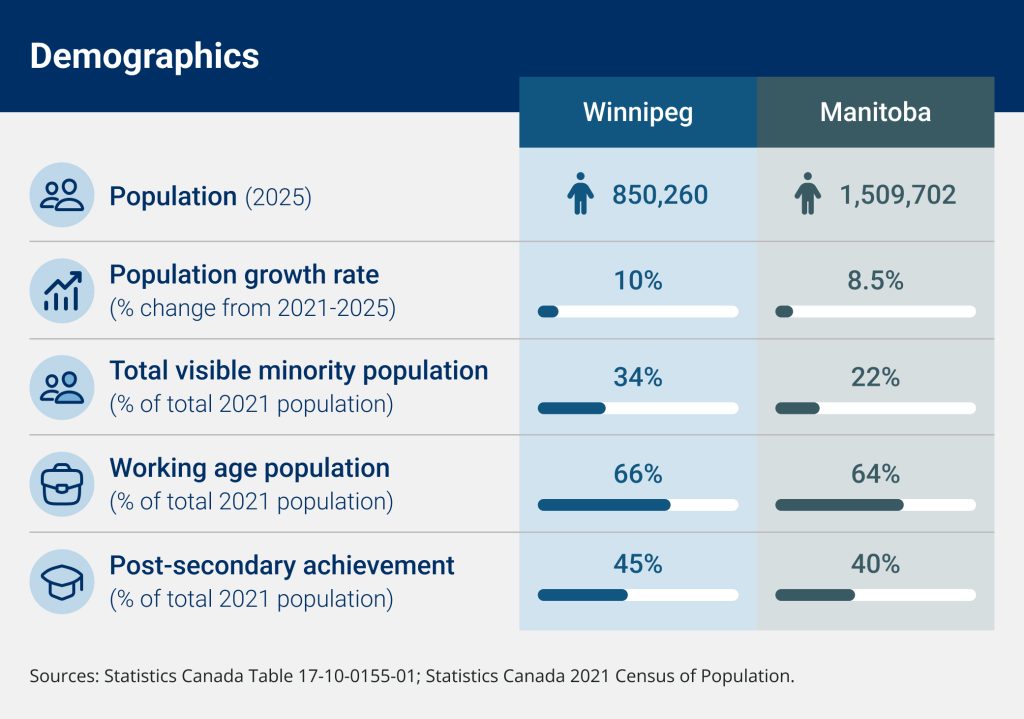
As of 2021, the city’s share of working age population (66%) is on par with that of the province (64%), as is post-secondary achievement (45% vs. 40%). Similarly, its unemployment rate (5.8%), as well as the average income ($50,120), house price ($394,600), and rent increase since 2021 (+20%) are closely aligned; however, the 2026 census may reveal changes to these trends.
Historically, Winnipeg has weathered economic downturns much better than other Canadian cities. It has a highly diversified economy, particularly for a Prairie city, with a significant presence of advanced manufacturing led by the aerospace industry, and large service and government sectors.1
Demographics
Local Economy
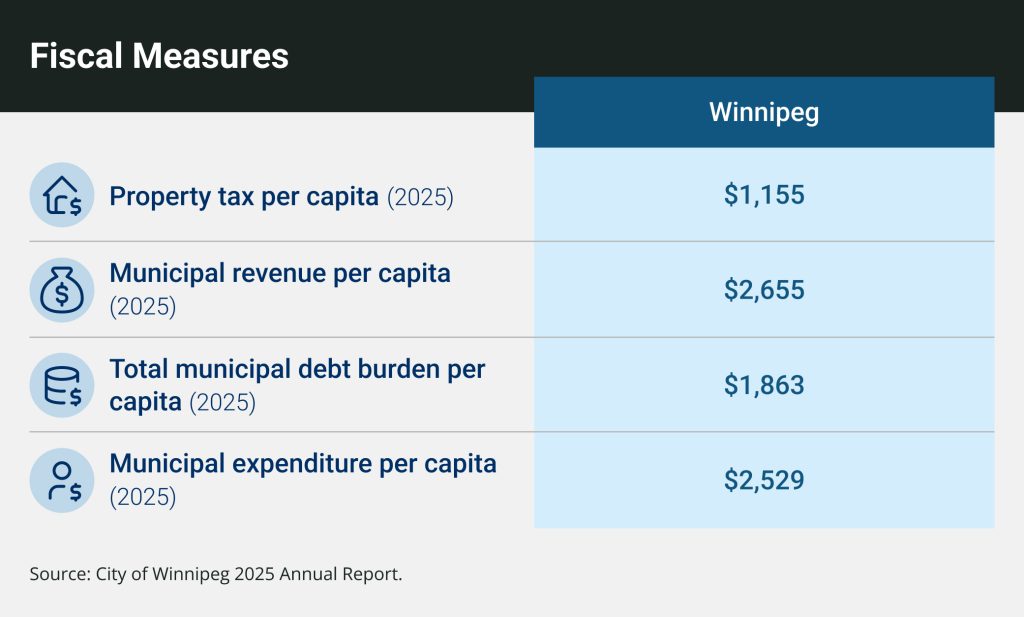
Fiscal Measures
The Political Landscape
Long known as “the crossroads of Canada,” centred on the intersection of Portage and Main, Winnipeg finds itself at a crossroads of its own as it heads into the 2026 municipal election. Like many large Canadian cities, Winnipeg struggles to maintain services and infrastructure amid public concerns over crime, housing, and homelessness.
While the 2022 mayoral election was one of the most competitive municipal contests in recent Canadian history, voter turnout was at its lowest since 1989 (37.5%). Recent polling indicates that Winnipeg residents are not optimistic about the City’s ability to tackle their most pressing concerns.2 Time will tell whether public unease will affect voter turnout in 2026.
Since the 2022 election, the province also elected a new NDP government. While the Province has not significantly increased its funding to the City, the relationship between the City and Province is more cordial today than it was in prior years. Winning in large part due to voter-rich Winnipeg, the NDP government has actively worked with the City to address pressing issues by providing funding for the Winnipeg Police Services’ retail theft initiative and funding housing for individuals living in encampments.
With at least five open council seats, Winnipeg continues its pattern of high councillor turnover. To date, nine incumbent councillors are running for re-election and one has yet to announce their intention.
Key Policy Challenges
Despite its diverse and resilient economy, the City faces persistent challenges with funding and maintaining services and infrastructure. Since 2022, council has increased the property tax at its fastest annual rate in over two decades (3.5% in 2023, 2024, and 2026, and 5.95% in 2025). However, Winnipeg has the lowest residential property taxes among Canada’s large cities,3 and the increases have not made up for prior decades of frozen and later, capped, increases. Despite providing funding for specific City initiatives, the Province has not substantially increased its contributions to the City’s coffers in this time, while its recent decision to remove the cap on the education property tax resulted in double-digit increases in many school divisions, making further municipal tax increases more difficult, politically.
Decades of deferring infrastructure maintenance and renewal to keep property taxes low has had visible consequences. After decades of delaying replacement of the Arlington Bridge, the City was forced to close it in 2023 over safety concerns. The City has since committed $22 million for demolition and design, but has not yet allocated funds for replacement.4 And, while Council has continued to prioritize road maintenance, it has embarked on few new major projects, aside from long-planned, controversial changes to the transit system. The City did issue $200 million in new bonds in early 2024 to support continuing improvements to the North End Sewage Treatment Plant and smaller projects such as the expansion of the St. James Community Centre.5
In addition, the city has increased existing fees and added new ones, while cutting some services and proposing cuts to others. For instance, while it funded new and expanded recreation facilities in some areas of the city,6 it has begun closing them elsewhere. The City has also proposed cuts to snow removal, community grants, and tree planting, but in response to public backlash, most have been put on hold.
While home ownership remains more affordable in Winnipeg than in other major Canadian cities, renting is expensive, and the stock of affordable rental housing is declining. The City is instituting sweeping changes to its zoning bylaws to secure federal housing funds, and is working with the private sector and Indigenous, provincial, and federal governments to address the housing shortage and costs.
Public concerns over a rise in open drug use, homeless encampments, derelict houses and buildings, arsons, retail thefts, and general affordability issues continue to dominate the local news. A recent poll found the public’s perception of the state of the city has soured, with 68% of respondents suggesting the city is getting worse.7 Whether or not public perceptions reflect conditions on the ground, they are likely to shape the outcomes of the 2026 election. While the city’s fiscal challenges remain critical, the concerns most likely to determine the election extend well beyond its capacity to address them on its own.
Notes
1 Stelman, U., and Moore, A. A. (2026). Winnipeg. In M. Horak, Z. Taylor, and J. Lucas (Eds.). City Politics in Canada (2nd ed., pp. 157–185). University of Toronto Press.https://utpdistribution.com/9781487569341/city-politics-in-canada/
2 Probe Research. (2026, June). Public view on the state of the city and election: The Free Press June 2026 Manitoba omnibus survey. https://probe-research.com/polls/winnipeggers-hold-negative-views-state-city
3 City of Calgary. (2025). City of Calgary Budget 2026. https://www.calgary.ca/content/dam/www/cfod/finance/documents/plans-budgets-and-financial-reports/2023-2026-service-plans-budgets/2026-budget-as-approved-dec-3-2025.pdf
4 City of Winnipeg. (2026, May 25). Arlington Bridge removal moves forward. [Press release] https://www.winnipeg.ca/news/2026-05-25-arlington-bridge-removal-moves-forward
5 City of Winnipeg. (2024a, January 25). Successful bond sale will fund key infrastructure projects. [Press release]. https://www.winnipeg.ca/news/2024-01-25-successful-bond-sale-will-fund-key-infrastructure-projects
6 City of Winnipeg. (2024b, January 22). City awards renovation grants to 13 community centres. [Press release]. https://www.winnipeg.ca/news/2024-01-22-city-awards-renovation-grants-13-community-centres
7 Probe Research. (2026, June). Public view on the state of the city and election: The Free Press June 2026 Manitoba omnibus survey. https://probe-research.com/polls/winnipeggers-hold-negative-views-state-city
Media Sources
Keele, J. (2024, February 8). How Winnipeggers feel about the city’s plan to close some pools. CTV News Winnipeg. https://www.ctvnews.ca/winnipeg/article/how-winnipeggers-feel-about-the-citys-plan-to-close-some-pools/
MacLean, C. (2022, October 28). Apathy, lack of engagement likely factors in Winnipeg’s 37% election turnout, Winnipeggers say. CBC News Manitoba. https://www.cbc.ca/news/canada/manitoba/apath-lack-of-engagement-low-winnipeg-voter0-1.6632330
Contributors

Aaron A. Moore
is professor of political science at the University of Winnipeg and a fellow at the Institute on Municipal Finance and Governance.
Institute on Municipal Finance and Governance
School of Cities University of Toronto
55 St. George St., Suite 853
Toronto, Ontario, Canada
M5S 0C9
e-mail: info.imfg@utoronto.ca
http://imfg.org
Series editors: Kohbod Khandan-Barani and Lisa D. Orchard
Footnote
Click to scroll to footnotes