City Context
Moncton is a city on the rise. It became New Brunswick’s largest city in 2016 – superseding Saint John, which had held that spot since the province’s creation. Between 2021 and 2024, Moncton grew at a rapid rate, trailing only Calgary for the highest growth among Metropolitan areas nationally. This recent and sudden boom has reshaped the city’s demographics and created several issues that are at the heart of the 2026 election.
Long considered the quintessential New Brunswick city, Moncton is currently undergoing a fundamental transformation. Officially bilingual, it is home to a substantial francophone minority, whose proportion in the city (28%) mirrors that of the province (30%). Although this cohabitation of English and French has historically been the city’s defining feature, recent growth has somewhat shifted its demographic composition. Visible minority representation surged from 2% in 2006 to 15% in 2021, making Moncton one of the province’s most diverse cities. All indicators suggest these trends have accelerated since the 2021 census.
Table 1. Demographics
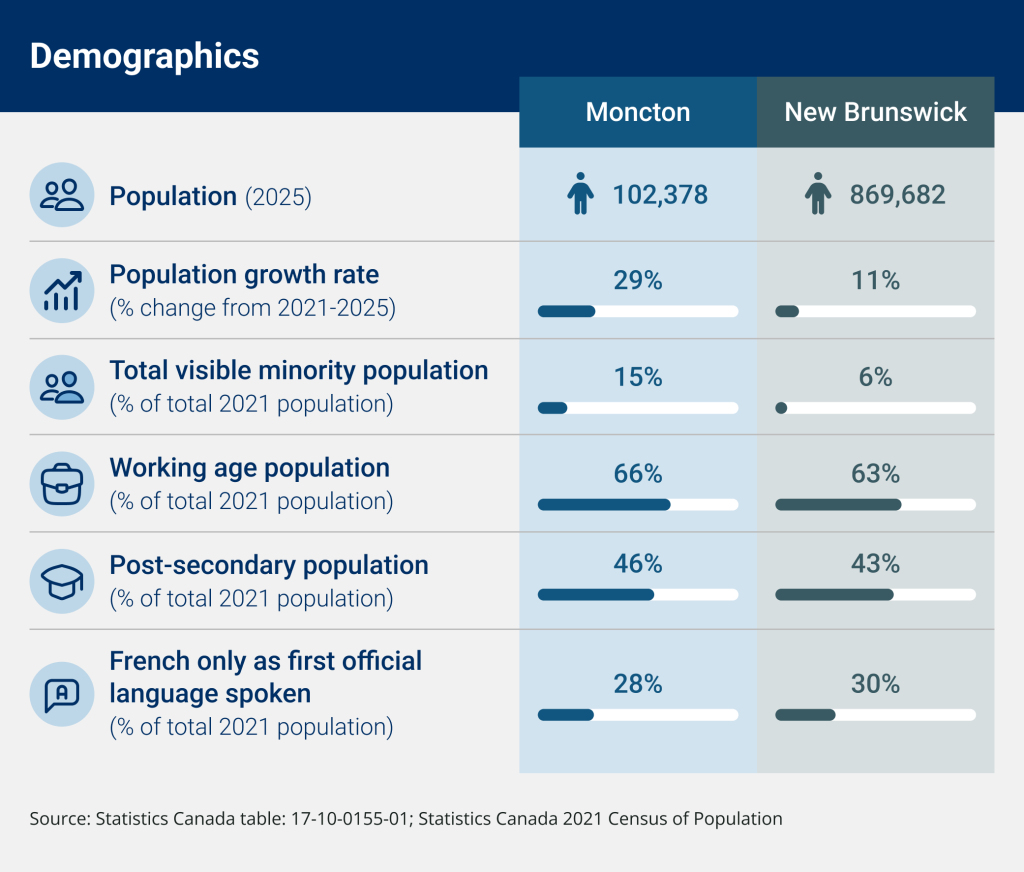
Table 2. Local Economy
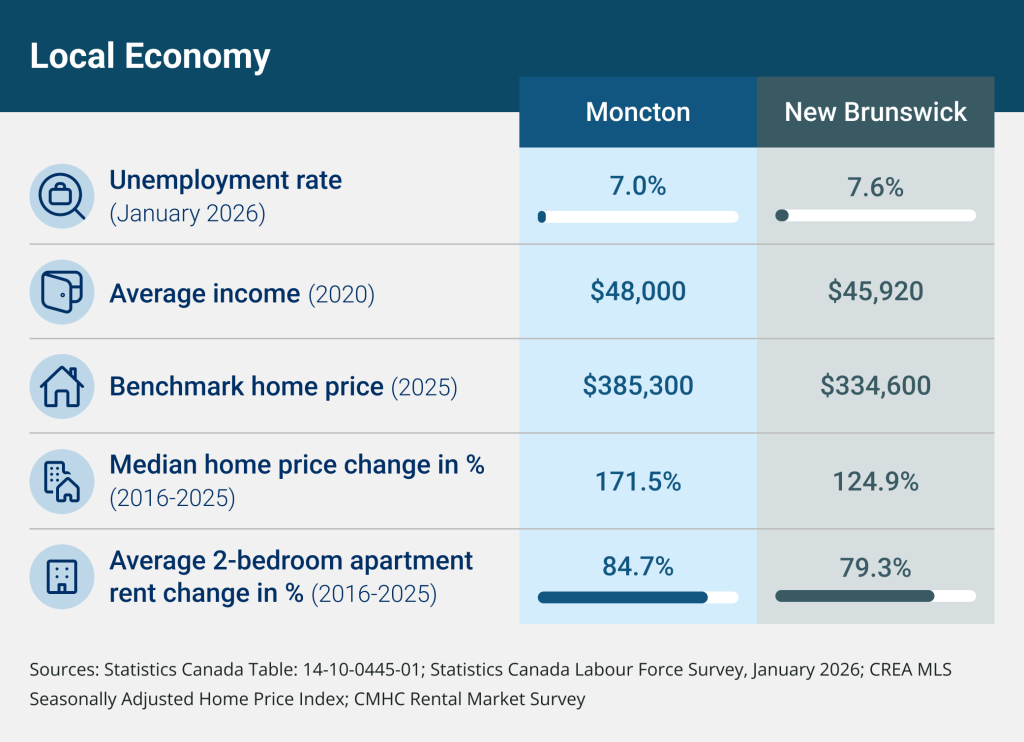
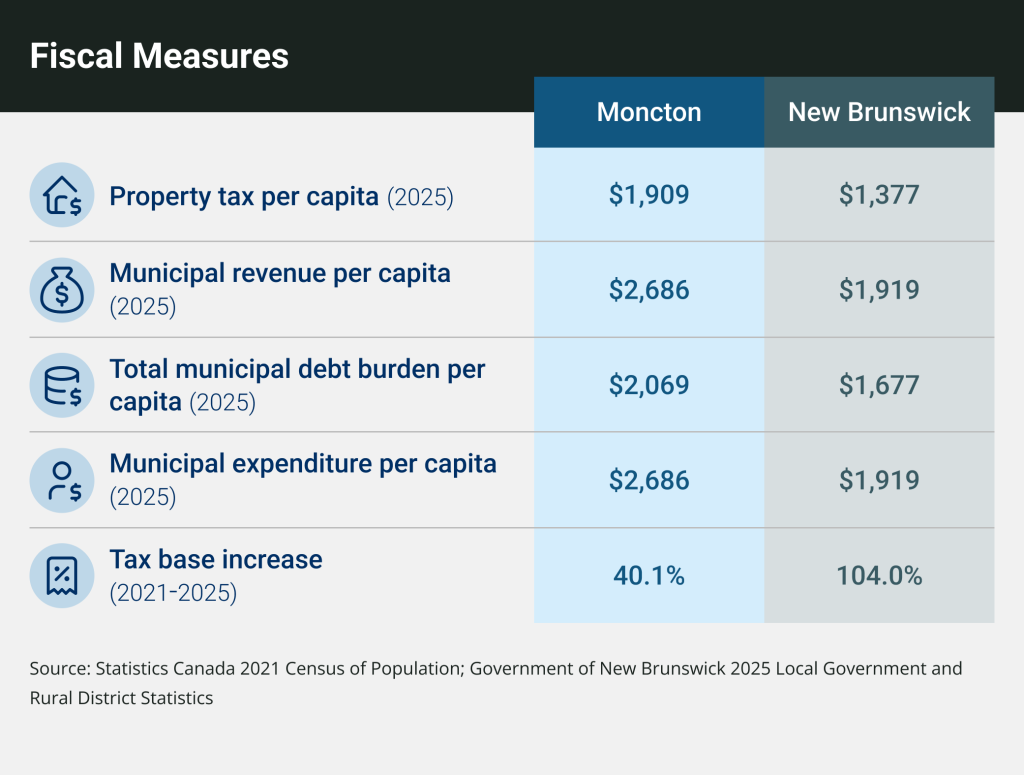
Table 3. Fiscal Measures
While these demographic changes have fuelled the city’s economic growth, they have also led to a housing crisis and public safety issues. These unprecedented demographic and social challenges form the backdrop to the 2026 municipal election.
The Political Landscape
The 2026 municipal election represents a major milestone for New Brunswick. The local governance reform of 2023 created 50 new municipalities, mostly out of previously unincorporated areas. Initial votes were held in the new municipalities in 2022, in the month preceding their official incorporation, but the 2026 cycle marks the first true transition of power for most of the province (50 out of 77 municipalities). Moncton emerged from this reform largely intact, other than annexing a small area in the northwest that added 650 citizens.
New Brunswick operates under a “weak mayor” system, where the mayor is essentially “first among equals” and there are no municipal political parties. Moncton’s city council comprises eleven elected officials: one mayor, two councillors-at-large, and eight ward councillors. In practice, this structure tends to inhibit centralized agenda-setting; without the discipline of party platforms, policy coalitions are typically unstable, ad hoc, and informal, shifting from one issue to the next. Interestingly, Moncton has been without an elected mayor since March 7, 2025, when Dawn Arnold – the city’s first female mayor, who had served since 2016 – was appointed to the Senate of Canada.
Key Policy Challenges
Given Moncton’s recent and rapid transformation, this election represents the city’s first “big city” vote and marks a defining evolution in its self-perception. Two political issues dominate: housing and public safety.
Moncton’s sudden and rapid demographic growth exerted significant pressure on its housing market and sparked a marked increase in homelessness. Moncton has historically been among the country’s most affordable cities, and although it remains affordable by national standards, the benchmark price of a home jumped by approximately 172% over the last decade, rising from $141,900 to $385,300. Average two-bedroom rents rose by 84.7% between 2016 and 2025, with the sharpest increase occurring after 2020. These escalating costs fuelled a surge in homelessness, which rose by between 800% and 1,000% (depending on the data used) over the past decade.1
Although social housing is a provincial responsibility in New Brunswick, it has nevertheless become a central municipal issue. What role should the city play in affordable housing? Should it maintain the status quo and work with the private and non-profit sectors to increase supply? Or should it create a municipal housing authority, which would give the city a more direct and proactive role in building and managing affordable housing units?
As the city weighs its role in housing management, its commitment to density provides the structural backdrop for this evolution. Moncton has been rapidly moving away from its traditional single-family zoning: nearly 80% of all new residential construction since 2021 consists of multi-unit buildings. In 2025, it adopted a bylaw allowing for the construction of four-unit residential buildings across the city, regardless of zoning. This densification of the urban fabric is particularly targeted in the downtown core, where surface parking lots – which currently occupy 42% of the area – represent significant opportunities for strategic infill development.
Alongside this sustained demographic and economic growth, notably in the downtown area, public safety concerns have also crystallized into a major political issue, amplified by the “Enough is Enough” campaign led by central business district stakeholders.2 Moncton’s Crime Severity Index spiked between 2021 and 2023, reaching the fourth-highest rank in Canada. Although the city slipped out of the national top ten in 2024, its crime rate remains among the highest in New Brunswick. The recent rise in crime coincides with the construction of a new $60 million RCMP police station set to open in late 2026. As one of the few Canadian cities of its size without a municipal police force, Moncton’s debate over safety is tied to its policing model.
The 2026 election comes as the city is coming to grips with the new challenges and opportunities brought by its recent growth and the accompanying move from small-town to big-city politics.
Notes
1. Alec Brooks, “Homelessness in Moncton: Understanding the Contributing Factors,” Journal of New Brunswick Studies 17, 1 (2025), pp. 55–72; also Human Development Council, “Homelessness Moncton dashboard,” New Brunswick Community Council Data Portal.
2. See https://www.enoughisenoughmoncton.ca/blank.
Media Sources
Akhtar, Khalil. “Moncton mayoral candidates discuss crime and public safety.” Information Morning – Moncton, CBC Radio, February 10, 2026.
Akhtar, Khalil. “Moncton mayoral candidates discuss homelessness and the cost of public services.” Information Morning – Moncton, CBC Radio, February 11, 2026.
Akhtar, Khalil. “Moncton mayoral candidates lay out vision for growth in the city.” Information Morning – Moncton, CBC Radio, February 12, 2026.
Cochrane, Alan. “Three candidates offering for mayor of Moncton in May 11 election.” Telegraph-Journal (Saint John), January 29, 2026.
Dauphin, Damien. “Trois hommes pour un fauteuil de maire sur fond d’insécurité croissante.” Le Moniteur acadien (Shediac), February 4, 2026.
Paquette, Stéphane. “Moncton: Shawn Crossman et Brian Murphy entrent dans la course. L’Acadie Nouvelle” (Caraquet), January 30, 2026.
Thévenin, Cédric. “Élections municipales de mai: Le conseiller Charles Léger sera candidat à la mairie de Moncton.” L’Acadie Nouvelle (Caraquet), January 24, 2026.
Authors

Mathieu Wade
Université de Moncton
April 2026

Gabriel Arsenault
Université de Moncton
April 2026
Footnote
Click to scroll to footnotes