City Context
As Canada’s largest city, with a population of more than 3 million, Toronto is a major economic and cultural centre. This standing is deeply linked to its diversity: more than half of Torontonians identify as a visible minority, making the city significantly more diverse than the rest of Ontario, and of Canada.1
Population growth has reinforced this position. Toronto continues to grow faster than the rest of the province, adding almost half a million residents between 2021 and 2025. Most of this growth occurred between 2021 and 2024, with the population remaining relatively stable in 2024–2025, when it declined by approximately 9,000 residents following federal changes to immigration policy.2
With this growth comes strong demand to live and work in Toronto. Housing is significantly more expensive than in the rest of Ontario, despite average city incomes being only slightly higher. This has contributed to a housing and homelessness crisis: more than 100,000 applicants remain on the waitlist for social housing,3 and an estimated 12,000 residents are experiencing homelessness.4
Population growth has also exacerbated traffic congestion and long commute times. Use of private vehicles account for half of all trips and 68% for trips longer than 16 km,5 with an average commute time of 29.7 minutes.6 Public transit is used by 27% of commuters, with an average commute time of 48 minutes.7 The wider Toronto region has the longest average commute (35 minutes) of any Canadian metropolitan area.8
Meeting these challenges has placed significant strain on City finances. Toronto’s roughly $19 billion annual operating budget and $63 billion 10-year capital plan reflect the scale of investment required to keep pace with population growth, and with the city’s aging infrastructure.9 The 2024 budget showed that the City faced a $1.8 billion operating pressure, which it reduced to about $1 billion in the 2026 budget through annual property tax increases (9.5% in 2024, 6.9% in 2025, and 2.2% in 2026).10 This helped the City earn a credit rating upgrade to AA+ in 2026,11 but its state-of-good-repair backlog remains large, and is projected to reach roughly $21 billion by 2033.12 Other major capital projects, such as the multi-billion-dollar Waterfront East LRT and the Gardiner Expressway rebuild, face rising costs.
Despite these challenges, Toronto remains an economic powerhouse. The city accounts for about 9% of Canada’s economic output and 23% of Ontario’s GDP, while the wider Toronto region contributes 20% of Canada’s GDP.13 Since 2009, Toronto’s economy has grown by an annual average of 2.2%, outpacing the national average of 1.8%. Yet this economic success has been uneven, with 11% of Torontonians living on low incomes.14
Table 1. Demographics
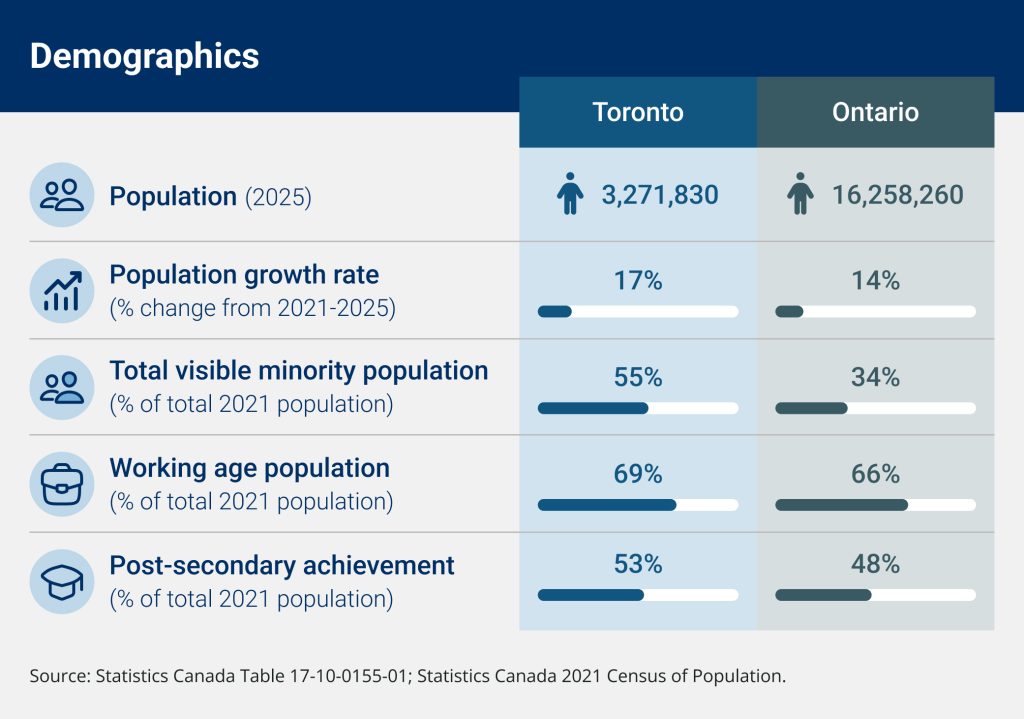
Table 2. Local Economy
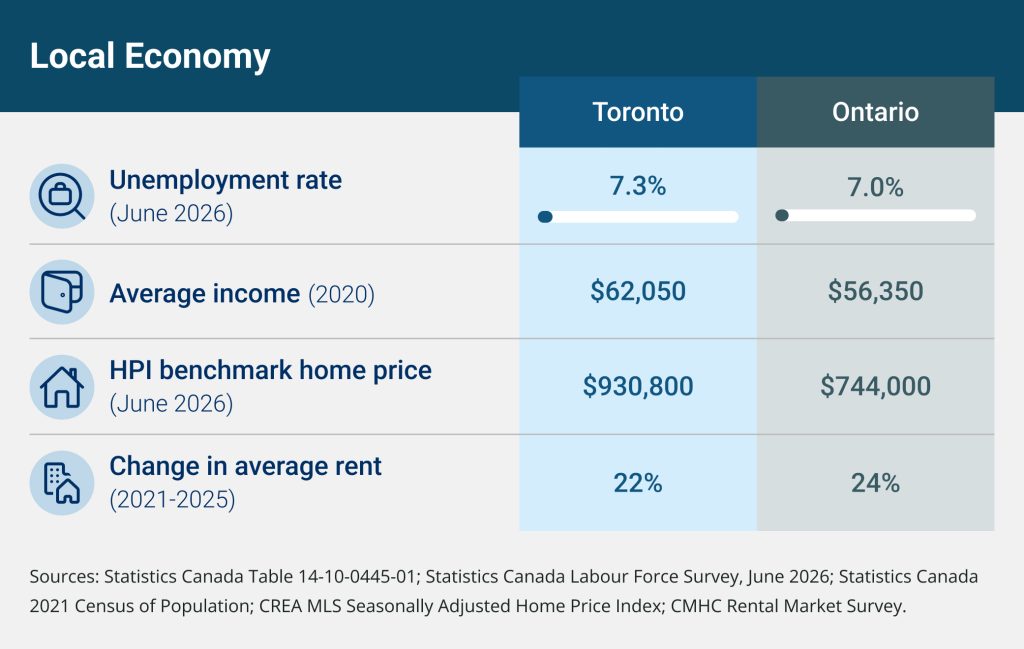
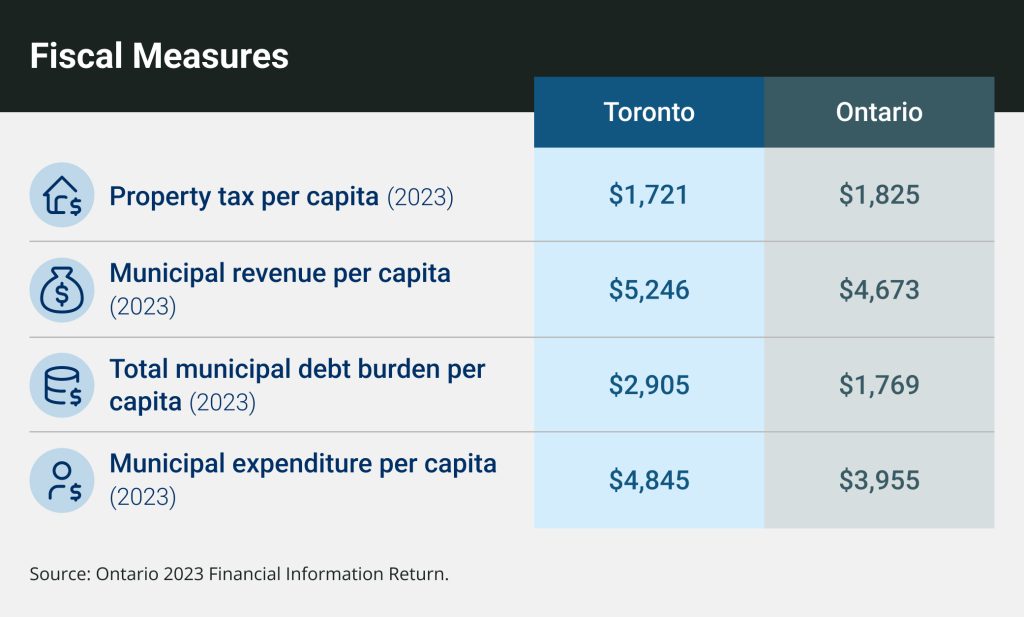
Table 3. Fiscal Measures
The Political Landscape
Toronto’s 2026 election follows an unusually short council term, which had been triggered by the unexpected resignation of Mayor John Tory in early 2023, just months after his re-election in 2022.15 After more than a decade of conservative leadership, former NDP Member of Parliament Olivia Chow became mayor, winning on a progressive platform.16 In 2026, Mayor Chow is running for re-election, and only four of Toronto’s 25 council seats are open races where no incumbent is seeking re-election.17 While Toronto councillors run as independents, organized advocacy blocs have emerged to support or endorse election candidates, including the left-of-centre Progress Toronto and the newer, conservative-leaning A Better City (“ABC”) Toronto.18
Since 2022, the City has operated under a “strong-mayor” system that gives the mayor power to veto certain council decisions and pass bylaws tied to provincially defined priorities, with support from just one-third of council. The mayor is also responsible for preparing and tabling the City budget and has executive authority to direct City staff and reorganize City departments.19 Mayor Chow has never used her veto or override powers at council, but has made at least a dozen substantive changes to council committees and City departments.20
Since the 2023 by-election, the City’s relationship with other orders of government has swung between fiscal cooperation and confrontation. A 2023 “New Deal” saw the Province assume responsibility for the Gardiner Expressway and Don Valley Parkway, while also providing roughly $1.2 billion in operating support.21 In 2026, the City also secured up to $1.5 billion from provincial and federal governments to reduce development charges by 40%–60%, after prior provincial legislation reduced annual City revenues from development charges, community benefits charges, and parkland levies by $230 million.22
At the same time, the Province has controversially intervened in local decision-making and matters involving City assets, including removing bike lanes,23 banning automated speed enforcement cameras,24 taking over the City’s stake in Ontario Place for a private spa redevelopment,25 and expropriating City lands for the proposed expansion of Billy Bishop Airport.26
Key Policy Challenges
Three major issues are shaping the municipal election: transportation and congestion, the cost-of-living and housing crisis, and public safety.
The latest polling indicates that traffic congestion is a top priority among Torontonians, with 88% viewing it as a serious problem in their part of the city.27 28 While Toronto’s relatively extensive public transit system provides an alternative to driving for many, reliability remains a challenge. Reduced speed zones continue to affect aging subway Lines 1 and 2, while streetcars remain particularly slow, with average speeds 13% below pre-COVID levels (11.7 km/h) and on-time performance below 60%.29 30 The Line 6 Finch LRT, opened in 2025, faces similar operational issues,31 though the Line 5 Eglinton LRT, opened in early-2026, has avoided these problems.32 The expansion of the cycling network also faces challenges, due in part to provincial legislation that was introduced to remove several well-used bike lanes on Toronto’s arterial roads.33
The cost of living is another major concern, with three-quarters of Torontonians identifying it as one of the city’s most pressing economic challenges, driven largely by high housing costs.34 The city has reached only about one-third of the provincially assigned target of 285,000 new homes by 2031.35 With private development stalling, City-led projects now account for roughly two-thirds of new housing starts.36 The City has loosened zoning restrictions to allow fourplexes citywide37 and sixplexes in nine wards38 without special approvals. It has also reduced development charges, using federal and provincial subsidies to offset the resulting funding gap, to support the construction of 44,000 new homes.39 Still, the City’s affordable housing program is only 46% toward its 2030 target,40 construction approvals continue to lag, Toronto Community Housing faces an estimated $2.2 billion repair backlog,41 and rents remain well above pre-pandemic levels, despite easing slightly in 2025.42
Public safety is the third major concern shaping the election, with nearly a quarter of Torontonians citing crime and safety as a top issue.43 These perceptions contradict recent crime statistics: nearly all Toronto Police Service community safety indicators, including auto theft, homicide, robberies, and hate crimes, declined between 2024 and 2025.44 Nevertheless, recent high-profile incidents, such as an open shooting at a popular summer festival,45 as well as persistent challenges related to drug use, mental health, and homelessness, have heightened public concerns.46 47
Toronto’s 2026 election takes place against a backdrop of long-term growth that has strengthened the city’s position as a major economic and cultural centre, but also created pressures the City administration has struggled to manage. These challenges, combined with a council term marked by an unprecedented mid-term mayoral transition, will shape the priorities and stakes of the upcoming election.
Notes
1Statistics Canada. (2026, September 13). Visible minority by gender and age: Canada, provinces and territories. https://www150.statcan.gc.ca/t1/tbl1/en/tv.action?pid=9810035101
2 Clayton, F., and Petramala, D. (2026, March 2). What a Difference a Year Makes: Population Growth Collapses in the Greater Golden Horseshoe in 2025. https://www.torontomu.ca/centre-urban-research-land-development/blog/blogentry104-what-a-difference-a-year-makes-population-growth-collapses-in-the-greater-golden-horseshoe-in-2025/
3 City of Toronto. (2026, May 13). Social Housing Waiting List Reports. https://www.toronto.ca/city-government/data-research-maps/research-reports/housing-and-homelessness-research-and-reports/social-housing-waiting-list-reports/
4 City of Toronto. (2026, April 28). Street Needs Assessment. https://www.toronto.ca/community-people/housing-shelter/homeless-help/about-torontos-shelter-system/street-needs-assessment/
5 Toronto Transit Commission. (2025, July 10). Framework for Ridership Growth. https://www.toronto.ca/legdocs/mmis/2025/tts/bgrd/backgroundfile-257313.pdf
6 Statistics Canada. (2023, November 15). Commuting duration by main mode of commuting and time arriving at work: Canada, provinces and territories, census divisions and census subdivisions of work. https://www150.statcan.gc.ca/t1/tbl1/en/tv.action?pid=9810050301&geocode=A00053520005
7 Statistics Canada. (2023, November 15). Commuting duration by main mode of commuting and time arriving at work: Canada, provinces and territories, census divisions and census subdivisions of work. https://www150.statcan.gc.ca/t1/tbl1/en/tv.action?pid=9810050301&geocode=A00053520005
8 Statistics Canada. (2025, August 26). Average commute time for the 15 largest census metropolitan areas for the month of May, 2021 to 2025.https://www150.statcan.gc.ca/n1/daily-quotidien/250826/t004a-eng.htm
9 City of Toronto. (2026). 2026 City of Toronto Budget Summary. https://www.toronto.ca/wp-content/uploads/2026/05/8f04-2026-City-of-Toronto-Budget-Summary.pdf
10 City of Toronto. (2024). 2024 City of Toronto Budget Summary. https://www.toronto.ca/wp-content/uploads/2024/05/9569-2024-City-of-Toronto-Budget-Summary.pdf; City of Toronto. (2025). 2025 City of Toronto Budget Summary. https://www.toronto.ca/wp-content/uploads/2025/05/96a6-2025-City-of-Toronto-Budget-Summary.pdf; City of Toronto. (2026). 2026 City of Toronto Budget Summary. https://www.toronto.ca/wp-content/uploads/2026/05/8f04-2026-City-of-Toronto-Budget-Summary.pdf
11 City of Toronto. (2026, February 10). City of Toronto’s 2026 Budget now final –focuses on affordability, service stability and financial sustainability. [Press release]. https://www.toronto.ca/news/city-of-torontos-2026-budget-now-final-focuses-on-affordability-service-stability-and-financial-sustainability/;
13 City of Toronto. (2026). 2026 City of Toronto Budget Summary. https://www.toronto.ca/wp-content/uploads/2026/05/8f04-2026-City-of-Toronto-Budget-Summary.pdf; City of Toronto. (2026, January 8). Budget Launch. https://www.toronto.ca/legdocs/mmis/2026/bu/bgrd/backgroundfile-261523.pdf
14 City of Toronto. (2024, November). Sidewalk to Skylines –A 10-year action plan for Toronto’s Economy (2025-2035). https://www.toronto.ca/legdocs/mmis/2024/ec/bgrd/backgroundfile-249432.pdf
17 City of Toronto. (2026, August 30). 2026 Municipal Election List of Certified Candidates & Third Party Advertisers. https://www.toronto.ca/city-government/elections/candidate-list/
19 Strong Mayors, Building Homes Act, 2022, S.O. 2022, c. 18. https://www.ontario.ca/laws/statute/s22018
22 City of Toronto. (2026, June 23). City of Toronto secures $1.5 billion in Canada-Ontario Partnership to Build funding to support housing and reduce development charges. https://www.toronto.ca/news/city-of-toronto-secures-1-5-billion-in-canada-ontario-partnership-to-build-funding-to-support-housing-and-reduce-development-charges/;
24 Government of Ontario. (2025, September 25). Ontario Protecting Taxpayers by Banning Municipal Speed Cameras. [Press release]. https://news.ontario.ca/en/release/1006534/ontario-protecting-taxpayers-by-banning-municipal-speed-cameras
27 Mainstreet Research. (2026, June 23). Bradford and Chow matchup could be close. https://www.mainstreetresearch.ca/post/bradford-and-chow-matchup-could-be-close
28 Liaison Strategies. (2026, May 14). Toronto: Chow 50%, Bradford 37%; Traffic Frustration Dominates City Mood. https://press.liaisonstrategies.ca/toronto-chow-50-bradford-37-traffic-frustration-dominates-city-mood/
29 Toronto Transit Commission. (n.d.). Reduced Speed Zones. https://www.ttc.ca/riding-the-ttc/Updates/Reduced-Speed-Zones
30 Toronto Transit Commission. (2026, July). CEO’s Report. https://cdn.ttc.ca/-/media/Project/TTC/DevProto/Documents/Home/Transparency-and-accountability/Reports/CEO-Reports/2026/July-CEO-Report-2026—to-be-posted.pdf?rev=07ad47df06d54252b532482e1d4e3967&hash=C1EC1C5B9D00A0625BAA38488E4C48A9
34 Toronto Region Board of Trade. (2026, August 21). New polling shows Toronto residents worried about the city’s future, want City Hall to move faster on affordability and economic growth. https://bot.com/News/New-polling-shows-Toronto-residents-worried-about-the-citys-future
35 City of Toronto. (n.d.). Housing Data. https://www.toronto.ca/city-government/data-research-maps/toronto-housing-data-hub/housing–data/
36 City of Toronto. (2025, October 30). Unlocking affordable housing: City of Toronto provides annual progress update on Housing Action Plans. https://www.toronto.ca/news/unlocking-affordable-housing-city-of-toronto-provides-annual-progress-update-on-housing-action-plans/
37 City of Toronto. (n.d.). Multiplex Study. https://www.toronto.ca/city-government/planning-development/planning-studies-initiatives/multiplex-housing/multiplex-study-2-4-units/
38 City of Toronto. (n.d.). Multiplex Housing. https://www.toronto.ca/city-government/planning-development/planning-studies-initiatives/multiplex-housing/
40 City of Toronto. (2025, October 30). Unlocking affordable housing: City of Toronto provides annual progress update on Housing Action Plans. https://www.toronto.ca/news/unlocking-affordable-housing-city-of-toronto-provides-annual-progress-update-on-housing-action-plans/
41 City of Toronto. (2026). 2026 Budget Notes Toronto Community Housing Corporation. https://www.toronto.ca/legdocs/mmis/2026/bu/bgrd/backgroundfile-261373.pdf
42 Toronto Regional Real Estate Board. (2025). Rental Market Report. https://trreb.ca/wp-content/files/market-stats/rental-reports/rental_report_Q3-2025.pdf
43 Mainstreet Research. (2026, June 23). Bradford and Chow matchup could be close. https://www.mainstreetresearch.ca/post/bradford-and-chow-matchup-could-be-close
44 Toronto Police Service. (2026, June). 2025 Chief’s Annual Report. https://www.tps.ca/media/filer_public/f1/f1/f1f1cd5f-ce16-4577-b3ec-bf1cd25fd935/5bd9cc5a-f0bb-43bc-94bb-00cb21fb3a37.pdf
47 City of Toronto. (2026, August 10). Downtown East Action Plan. https://www.toronto.ca/city-government/accountability-operations-customer-service/long-term-vision-plans-and-strategies/downtown-east-action-plan/
Media Sources
12 Harrison, L. (2026, January 14). Why Toronto may defer some infrastructure work – even as backlog grows. CBC News. https://www.cbc.ca/news/canada/toronto/toronto-infrastructure-state-of-good-repair-backlog-9.7043926
15 CBC News. (2023, February 17). John Tory officially resigns as Toronto mayor after admitting to extramarital affair. CBC News. https://www.cbc.ca/news/canada/toronto/john-tory-final-day-mayor-1.6751834
16 Powers, L. (2023, June 26). Olivia Chow elected Toronto’s next mayor, vowing a more progressive approach at city hall,” CBC News. https://www.cbc.ca/news/canada/toronto/toronto-mayor-byelection-2023-results-1.6888539
18 McGrath, J. (2026, May 6). ANALYSIS: Toronto needs political parties. TVO. https://www.tvo.org/article/analysis-toronto-needs-political-parties
20 See the Toronto Star’s searchable database of strong-mayor decisions in Ontario municipalities: https://www.thestar.com/interactives/strong-mayor-powers-look-up-your-city/article_c4cc48c7-21bd-42a0-9a5d-3a17dd801615.html
21 25 Carter, A. (2023, November 27). Toronto uploads Gardiner, DVP to province, steps aside on Ontario Place redevelopment. CBC News. https://www.cbc.ca/news/canada/toronto/chow-ford-announcement-monday-1.7040823
22 Draaisma, M. (2022, November 24). Fearing $230M yearly loss, Toronto council to ask Ford government to pause new housing bill. CBC News. https://www.cbc.ca/news/canada/toronto/toronto-city-council-ontario-new-housing-bill-pause-1.6663734
23 Harrison, L., and Silva Ponte, G. (2026, August 14). Ontario Court of Appeal says Ford can rip out Toronto bike lanes. CBC News. https://www.cbc.ca/news/canada/toronto/bike-lane-removal-appeal-court-decision-9.7307310
26 Snisarenko, A. (2026, July 29). Toronto council demands Ford government return land province took for rejected Billy Bishop Airport expansion. CBC News. https://www.cbc.ca/news/canada/toronto/city-council-billy-bishop-expansion-plan-9.7289624
31 Colley, M. (2026, January 10). Riders say the Finch West LRT is ‘horrible’ and a ‘failed start’. Toronto Star. https://www.thestar.com/news/gta/riders-say-the-finch-west-lrt-is-horrible-and-a-failed-start-whats-gone-wrong/article_4bba5064-55df-48d4-95b8-830e7f6918e0.html
32 Callan, I. (2026, February 27). Eglinton Crosstown LRT hits 98% of in-service target during opening weeks. Global News. https://globalnews.ca/news/11709943/eglinton-crosstown-lrt-success-launch
33 Popoff, T. (2026, August 14). Ford government wins court battle to remove downtown Toronto bike lanes. Global News.https://globalnews.ca/news/12021587/ford-government-wins-court-battle-bike-lanes/
39 Freeman, J. (2026, June 23). Toronto to get $1.5 billion from province and feds to reduce development charges. CP24. https://www.cp24.com/local/toronto/2026/06/23/toronto-to-get-15-billion-from-province-and-feds-to-reduce-development-charges/
45 Callan, I. (2026, July 11). 2 dead, 4 injured after ‘exchange of gunfire’ in the middle of Toronto street festival. Global News. https://globalnews.ca/news/11962592/2-dead-in-toronto-street-festival-shooting/
46 Draaisma, M. (2026, June 9). City staff to find solutions for downtown Toronto park after concerns over violence, vandalism. CBC News. https://www.cbc.ca/news/canada/toronto/barbara-hall-park-economic-and-community-development-committee-9.7229476
Contributors
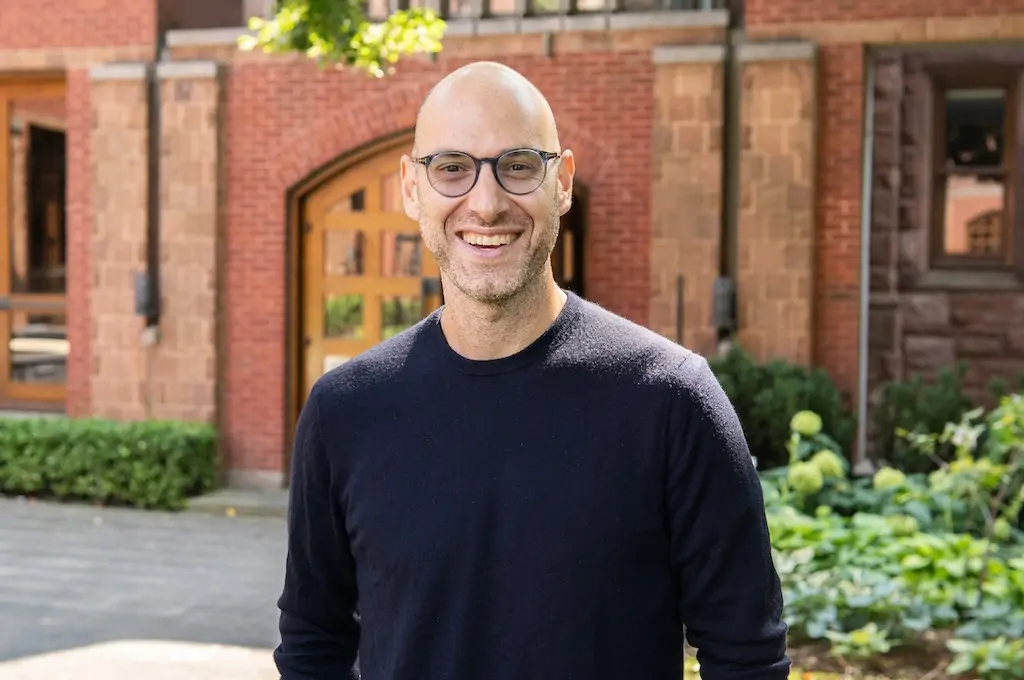
Gabriel Eidelman
is associate professor, teaching stream, at the University of Toronto’s Munk School of Global Affairs and Public Policy, and director of U of T’s Urban Policy Lab.

Young Luk
is a graduate of the Master of Public Policy program at the Munk School and former graduate fellows atthe Urban Policy Lab.

Ananya Yadav
is a graduate of the Master of Public Policy program at the Munk School and former graduate fellows atthe Urban Policy Lab.
Institute on Municipal Finance and Governance
School of Cities University of Toronto
55 St. George St., Suite 853
Toronto, Ontario, Canada
M5S 0C9
e-mail: info.imfg@utoronto.ca
http://imfg.org
Series editors: Kohbod Khandan-Barani and Lisa D. Orchard
Footnote
Click to scroll to footnotes